
AquaTwin Sewer continues to expand the way subsurface wet-weather response can be modeled in sewer collection systems. A new Soil Storage subsurface hydrology method has been developed to represent rainfall-driven infiltration and groundwater response through an explicit two-zone storage formulation. Rather than relying only on prescribed response hydrograph (aka RTK unit hydrograph), the Soil Storage method tracks how infiltrated water is stored, percolated, divided between sewer infiltration and groundwater recharge, and subsequently released from the subsurface while maintaining water balance.
The rigorous methodology consists of an upper soil storage zone and a lower groundwater storage zone. Surface infiltration enters the upper zone and once the upper-zone storage rises above a user-defined percolation threshold, water begins to drain downward. A specified fraction of that percolation can be routed to the sewer as rainfall-induced infiltration, while the remaining fraction recharges the lower groundwater zone. The lower zone can then lose water through baseflow and, when enabled, can contribute groundwater infiltration to the sewer depending on the available groundwater head relative to the receiving sewer node head.
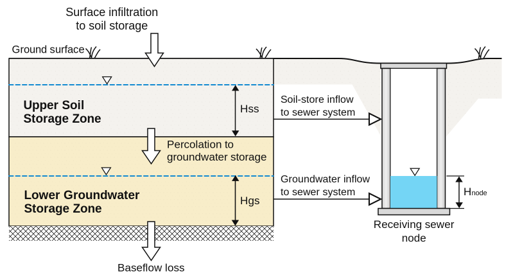
Figure 1: Conceptual representation of the Soil Storage method. Surface infiltration is stored in the upper soil zone, percolation is divided between rainfall-induced infiltration and groundwater recharge, and the lower groundwater zone can release water through baseflow or groundwater infiltration to the receiving sewer node.
One of the main objectives of this formulation is to allow different subsurface responses to emerge from the storage and drainage parameters themselves. The example below compares two subcatchments subjected to the same rainfall forcing but configured with contrasting percolation behavior. Subcatchment 37602 represents a fast-response condition, while Subcatchment 56735 represents a slower and more persistent response. The difference is immediately visible in the percolation hydrographs: 37602 develops sharp event-driven peaks and returns rapidly toward zero, whereas 56735 responds later, at a much lower rate, and with a longer recession.
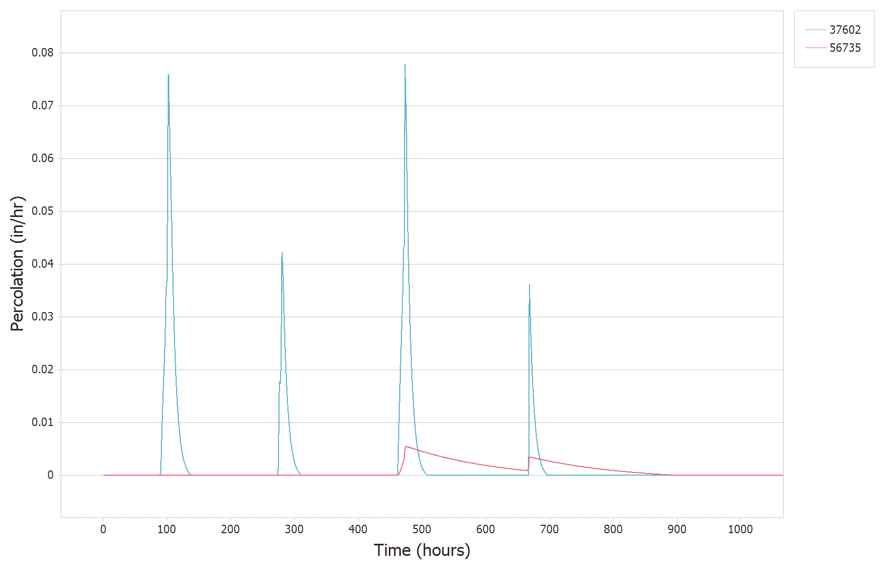
Figure 2: Percolation response for a fast-response subcatchment (37602) and a slower-response subcatchment (56735). The same rainfall forcing produces distinctly different peak magnitudes, timing and recession behavior as a result of the Soil Storage parameters.
This behavior is important because the wet-weather response develops naturally from how water is stored and moves through the subsurface, rather than being imposed as a predefined inflow shape. Some areas may respond quickly to rainfall, producing sharp infiltration peaks that recede soon after the storm, while others can retain water longer and generate a smaller but more persistent response. As water moves downward, part of it can enter the sewer system as rainfall-induced infiltration while the remainder continues into groundwater storage, creating both fast and slow subsurface pathways within the same framework. This allows the model to represent a wide range of realistic wet-weather responses, including differences in timing, peak magnitude, and recession, without forcing every subcatchment to behave the same way.
The resulting rainfall-induced infiltration response retains the timing characteristics created by the upper-zone storage and percolation process. In the fast-response subcatchment, distinct infiltration peaks develop following the rainfall events and recede quickly. The slower subcatchment produces a much smaller and more persistent response. Because the response is generated through the storage formulation, the model can represent different combinations of onset, peak magnitude and recession without requiring every subcatchment to follow the same wet-weather response pattern.
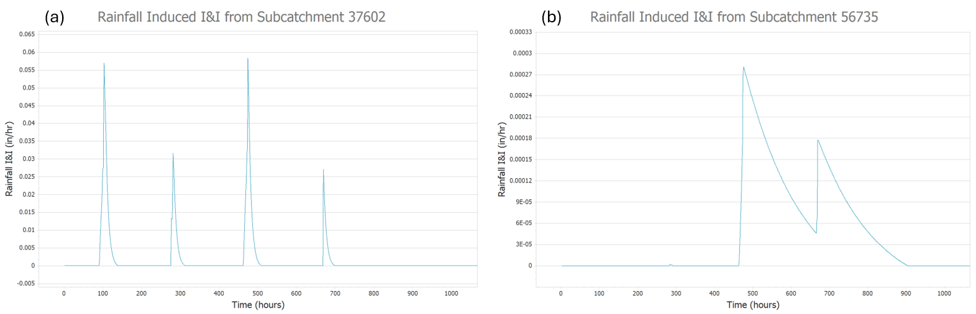
Figure 3: Rainfall-induced infiltration response for Subcatchments (a) 37602 and (b) 56735. The fast-response configuration produces pronounced event-driven infiltration, while the slower configuration produces a delayed and much smaller sewer contribution.
At the system level, these subsurface responses translate into additional wet-weather flow. For the representative rainfall event below, the Soil Storage simulation produces a higher outfall peak and a longer recession than the standard EPA SWMM subsurface hydrology run as rainfall-induced infiltration continues to contribute flow.
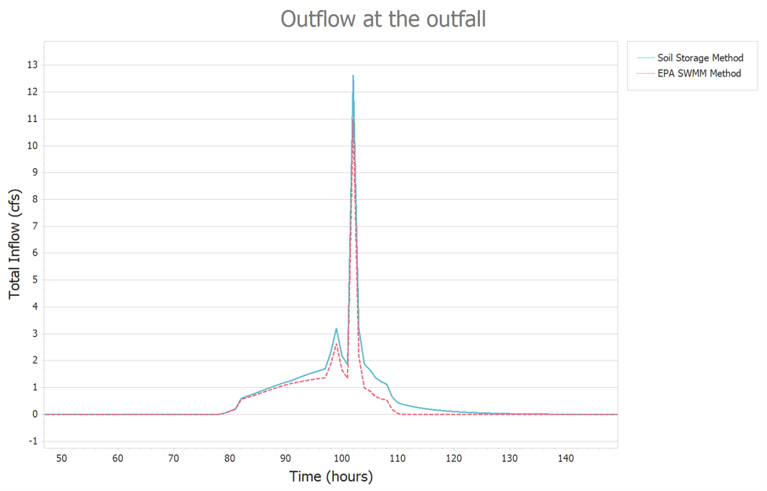
Figure 4: Outfall hydrograph for a representative rainfall event. Compared with the standard EPA SWMM hydrology run, the Soil Storage simulation shows additional wet-weather flow and a longer recession as rainfall-induced infiltration from the subsurface storage response reaches the collection system.
The principal benefit of the new Soil Storage method is therefore not simply that it adds another rainfall-related inflow option. It provides an integrated subsurface water-balance framework in which infiltration, evapotranspiration, storage, percolation, rainfall-induced infiltration, groundwater recharge, baseflow and groundwater infiltration are linked as parts of the same hydrologic system. This gives sewer modelers a more transparent way to represent systems where both fast rainfall-driven response and slower subsurface persistence are important. AquaTwin Sewer provides users with a practical and physically meaningful tool for representing subsurface contributions to sewer flow while preserving the robustness expected from a production hydraulic model.